
BAuA change in the law 2026: the end of permanent baiting independent of infestation (BUD) and the alternatives available
A landmark change in pest control legislation takes effect on 1 July 2026: permanent baiting independent of infestation (known in Germany as BUD) using anticoagulant rodenticides will be prohibited by the BAuA. That means continuously placing poison bait to prevent pests is no longer permitted. Companies, municipalities and above all professional pest controllers face the challenge of adapting their control strategies and finding more environmentally friendly, more sustainable alternatives.
But what lies behind the change in the law, and what solutions exist for effective rodent control? traplinked has the answers.

What will the change in the law from 2026 mean for the industry?
Who decides on the ban on permanent baiting?
The BAuA (German Federal Institute for Occupational Safety and Health) is a German federal authority concerned with protecting safety and health at work. Among other things it researches, advises and regulates the handling of hazardous substances, including biocides such as anticoagulants. The BAuA plays a central role in implementing and monitoring legal requirements in chemicals law, including the Biocidal Products Regulation. That is why it is also the authority deciding on the BUD ban from 2026.
Why is permanent baiting being banned by the BAuA?
Anticoagulants are highly effective but problematic active substances that inhibit the blood clotting system of rodents. They accumulate in the environment and in food chains and can endanger not only rats and mice but also wildlife, pets and even people. Second-generation anticoagulants in particular are considered persistent, bioaccumulative and toxic (PBT substances).
Because these substances meet the exclusion criteria of the EU Biocidal Products Regulation (528/2012), their use is strictly regulated. Since 2018 their use has been tied to a risk assessment and special protective measures. Until now there were exemptions for rodenticides in certain situations and areas of application.
That is now changing, and the next step follows: using these substances without first establishing an infestation – that is, permanent baiting independent of infestation – will be prohibited in Germany from July 2026.
What does the BAuA change in the law mean for businesses and pest controllers?
Until now many operations have relied on permanent baiting with anticoagulants to prevent infestation. From 2026 that is no longer permitted. In future, an infestation must be established before rodenticides may be used. That determination can be made by digital systems, by non-tox bait or by visual inspection.
As a result, pest control becomes more laborious for companies working conventionally. Visual inspections or toxin-free lure baits are time-consuming and not always practical. From 2026 anticoagulant poison baits may only be used for active control. During control the bait must be checked at least weekly.
The duration of a control measure is generally limited to 35 days, with the exact period set by the approval conditions of the product used. Once that period expires, the measure may not simply be extended. Instead a fresh risk assessment must be carried out, the control strategy adjusted where necessary, and the case re-evaluated after documentation (source: TRNS).
For companies and professional pest controllers that means:
Increased workload for manual checks
Rising costs through more frequent inspections
Higher requirements for documentation and risk assessment
Digital snap traps as an alternative to BUD
On one point many experts agree: whoever switches to digital monitoring early will not only be legally compliant in 2026 but will also operate more efficiently and with more future security than the competition.
Digitally monitored snap traps from traplinked offer a safe, sustainable and legally compliant alternative to permanent baiting.
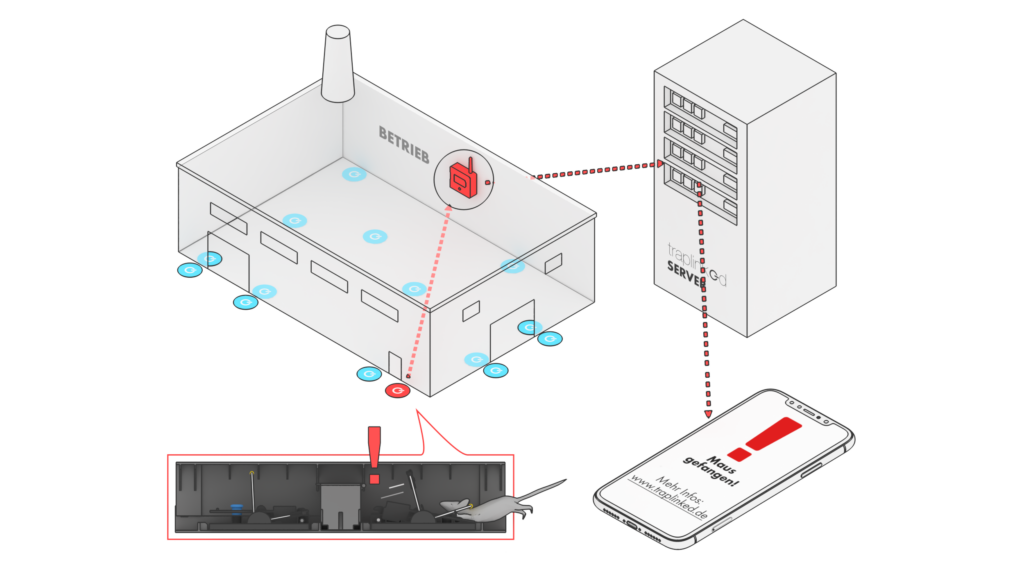
These traps work without poison and allow continuous, automatic monitoring of infestation. Using state-of-the-art sensors they detect every movement in real time and immediately send a report to the traplinked system. That means:
Infestation-based, targeted control: No unnecessary use of poison, but precise pest control.
Reduced inspection effort: Digital monitoring replaces daily manual inspections.
Compliance with the new legislation: You meet every legal requirement for 2026 and beyond.
Sustainability and environmental protection: No risk to pets, wildlife or the environment.
The traplinked systems – informed in real time
Digital trap systems from traplinked: the answer to the end of BUD
The market offers various solutions for digital pest monitoring. Some communicate over the mobile network to send sensor data to the pest controller. The generally better solution is a local network, for example using LoRaWAN technology, which suits companies & industry particularly well. That allows a continuous connection even in places with no mobile coverage. traplinked also builds on LoRaWAN technology.
This is how the digital traps from traplinked work: the sensor module sits centrally in all common snap trap tunnels and bait stations and records the status of the traps at intervals set by the user. Even when no trap is triggered and no bait is taken, the system reports back to the server to guarantee permanent certainty.
As soon as a trap is triggered or bait is consumed, the user receives a real-time notification through the traplinked app for iOS, Android or the web browser. The infestation history is documented automatically and can also be integrated into common documentation programs (Pestsoft, Pestscan and Hygitec). This automation and connectivity make it easy to judge the success and necessity of treatment measures, to react early and to nip the problem in the bud. These decisive advantages make the solutions from traplinked the ideal alternative to the end of BUD.
Conclusion: act now and switch to competitive, legally compliant pest control
The new legislation means a fundamental change in pest control. Whoever adapts to the new rules now will benefit in the long term from an efficient, economical and future-proof solution.
Rely on digital snap traps or digitally monitored bait boxes from traplinked – for toxin-free, intelligent and legally compliant pest control!
More on the topic can be found directly on the website of the BAuA. Scroll there to the section Product type 14 (rodenticides), where you will find all information and publications on the change in the law.
Contact us now and switch with us to modern, legally compliant pest control. traplinked is the answer to the end of permanent baiting independent of infestation.
Moritz Weigert
Frequently asked questions about the end of permanent baiting independent of infestation (BUD) from July 2026:
With BUD, poison bait (anticoagulants) was previously placed preventively and continuously, even when no actual infestation had been established. It is precisely this preventive practice that the BAuA prohibits from 1 July 2026. Poison bait may then no longer be left out “on suspicion”, but only once an infestation has been clearly established.
No, there is no general ban. Anticoagulant poison baits may still be used for acute control – but only once an actual infestation has been established beyond doubt. The duration of baiting is then strictly regulated (generally to 35 days) and the inspection interval is 7 days, meaning the bait must be checked at least every 7 days.
Besides breaching chemicals law, B2B companies above all risk losing essential certifications (such as IFS, BRC or HACCP schemes). Anyone unable to demonstrate a legally compliant determination of infestation at the next audit risks failing it, and with that potentially serious supply failures.
To keep protecting your business preventively, in future you will either have to use active-substance-free lure baits (non-tox) together with extremely time-consuming, frequent visual checks, or switch to digital trap systems from traplinked. The BAuA explicitly recommends the use of digital remote monitoring systems such as those from traplinked as a future-proof alternative. You can find out more here.
That is a common misconception. You do invest in smart hardware at the start, but in the medium term you save a great deal. In an analogue system you pay your service provider to manually check hundreds of empty traps. With digital 24/7 monitoring the technician only comes out when there is a genuine alert. Your budget moves from pointless staff time into real site security. You can find out more here.